
WILD PROPOSAL: Cheat Lake Rail Trail may Charge "Entry Fee" to Joggers, Cyclists, Dog Walkers, Fishermen, Boaters in 2026
You may have heard about the controversy surrounding Cheat Lake back in 2023. A Canadian company called Ontario Power Generation recently purchased the Cheat Lake hydroelectric dam located at the top of Monongalia County off Morgan Runs Road.
The dam was built in 1925 using water from the Cheat River to create the man-made Cheat Lake. The government seized some residents' homes and farmland to make this happen, which are now under the lake. Unlike most American lakes, which are owned by the government, Cheat Lake is different due to the hydroelectric plant. The entire waterway, dam, and park are controlled by a private company.
A branch of the U.S. Department of Energy called the Federal Energy Regulatory Commission (FERC) issues licenses to hydroelectric dam owners. License holders must follow federal regulations, which are in place to protect the public's use of the lake from harm by private companies. The public has to be provided a series of recreation opportunities under the Federal Power Act. FERC has the power to issue financial fines and even completely revoke a license if the licensee mistreats the public.
For nearly 100 years, the license holder was Allegheny Power/First Energy.
But not anymore. Cheat Lake is now owned by the Canadian government. Yes, Canada now has control over a lake in West Virginia. The dam has a series of shell companies: Lake Lynn Generation LLC, which is owned by Eagle Creek Renewable Energy LLC, which is owned by Ontario Power Generation Inc. (OPG). The single shareholder of OPG is the government of Ontario in what is called a "crown" corporation. Canadian crown corporations ultimately answer to the Canadian Parliament.
Morgantown residents formed an online campaign called Save Cheat Lake, arguing that a foreign country having control over American power generation and waterways could lead to major trouble and conflicts of interest. It turns out they may have been right.
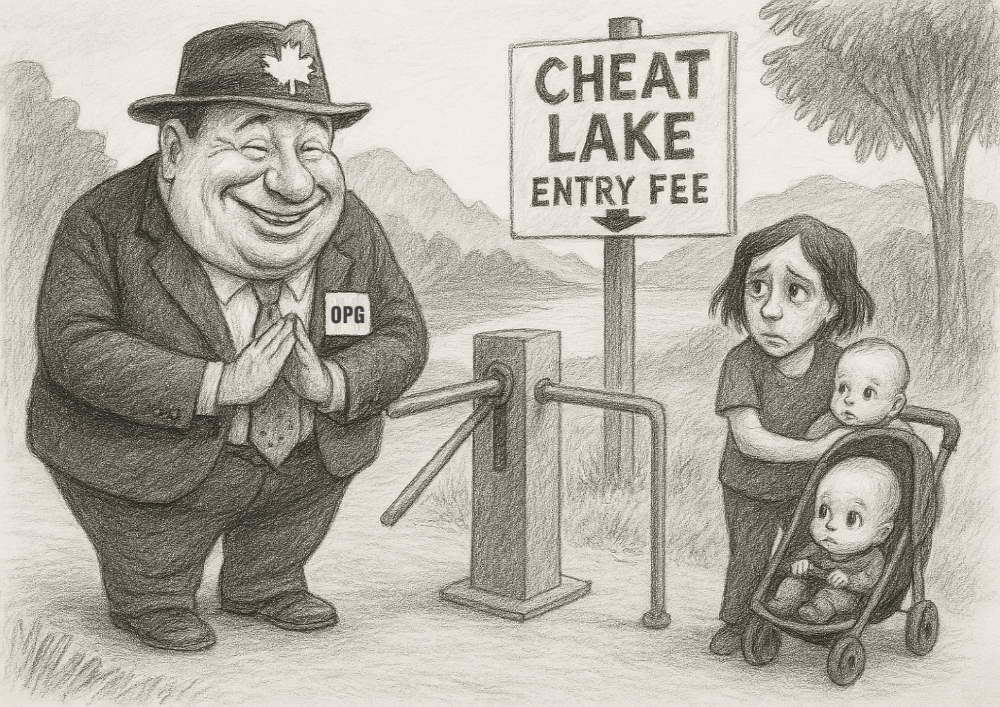
Entry Fee proposed to gain access to Cheat Lake Walking Trail & Park
In an August 22, 2025, letter addressed to FERC, a dam representative named Jody Smet writes that the dam is "evaluating the possibility of implementing such [an entry] fee beginning in 2026..." to help offset the costs of installing a new water line to the restrooms.
The existing water line was installed in 1999 by Allegheny Power/First Energy, who built the entire 4.5-mile park and facilities without asking for any entry fees. The water line now has a leak which they claim cannot be remedied for at least 2 years, or until 2027. New administration officials at FERC sent a stern letter to Jody Smet on August 7, 2025. FERC reminded the licensee of their legal obligation to provide restrooms and potable water at recreation facilities.
These federal responsibilities are not new. Canada knew about these agreements and obligations before purchasing the dam in 2019. The park and its maintenance are part of the exchange to gain access to Cheat Lake's valuable water flow, which generated $7,969,658 worth of wholesale clean power just in 2023, according to estimates in the FERC license application.
Smet responded to FERC by citing regulation 18 CFR 2.7, which states a licensee can charge fees.
The proposal says the fee would apply to "park goers," which presumably includes a variety of folks like joggers, cyclists, dog walkers, fishermen, and boaters. No exact pricing for the 2026 fee has yet been proposed.
Smet also stated that although the licensee is bound by federal law to provide potable water to the public under their recreation agreement, having a water fountain at a park is not "essential." However, Smet fails to cite what authority she makes such a claim under, beyond being a Vice President of the Canadian-owned LLC. One could argue Smet may have been attempting to browbeat FERC officials. Smet concluded by saying West Virginians can "bring their own" water.
The Save Cheat Lake campaign begs to differ with Canada and has submitted a 39-page report to the U.S. federal government, alleging they have evidence the licensee may have lied to FERC and is in serious violation of multiple federal statutes. The report is set to be entered into the public record on the FERC website tonight.
What do you think, Morgantown? Does Canada really think we will queue behind quarter-operated turnstiles for the privilege to walk on a gravel rail trail?
Public Document: Eagle Creek Jody Smet August 22 2025 Response to FERC.pdf